TRAVEL JOURNAL · HIMACHAL PRADESH
The Road to Spiti: A Journey I Keep Wanting to Relive
We set out as two friends travelling with strangers. Somewhere between changed plans, village conversations, a night under the stars and our first snowfall, the group became part of the story.
Spiti had been on my list for a long time. I had seen the photographs: the winding roads, the monasteries, the cold desert mountains and the impossibly blue water of Chandratal. I expected the scenery to be beautiful. What I hadn’t expected was how much I would remember the people, the unplanned stops and the small moments in between.
Disha and I joined a group trip with around seventeen or eighteen travellers. We were two friends among people we had never met: a few college friends from Delhi, travellers from Hyderabad and other parts of South India, a newly married couple, two brothers, solo travellers and our trip captain. We were both quite introverted, so at the beginning we weren’t sure how quickly we would settle in.
We had a broad plan: travel through Kinnaur into Spiti, continue towards Kunzum Pass and Chandratal, and return through Manali. We did not visit every place that appears on a typical Spiti circuit. Some stops were missed, some were only part of the route around us, and the trip changed as the road demanded. Looking back, that uncertainty became part of what made it memorable.
01 / THE BEGINNING
We Started as Strangers
Our first plan was to reach Chitkul. But the road had its own idea. A long traffic jam stretched for kilometres, and we lost around three to four hours. We crossed Sangla, but continuing to Chitkul would have meant arriving very late, possibly after dark. So the plan changed. We did not make it to Chitkul that evening.
Instead, we stopped at a viewpoint overlooking a river and a wide valley. At first, there was the disappointment of missing a place we had been looking forward to. Then someone put music on. People got out of the vehicle, climbed onto the van and started dancing. For about half an hour, the viewpoint turned into an unexpected little party.
That is one of the first moments I remember clearly. We were still strangers. We didn’t know whether we would stay in touch after the trip or ever meet again. But for those few minutes nobody seemed concerned about that. Nobody was trying to look cool. We were simply enjoying ourselves.
We had no idea who would become a friend. We only knew that the music was playing and nobody wanted the moment to end.
A different kind of stop
Because the original plan had changed, an alternative stay was arranged in a village. It was a simple place run by a local woman and her family. It wasn’t the accommodation we had imagined, but our host welcomed us warmly and made sure we had food and somewhere to rest.
Late that night, around eleven or midnight, I noticed a library nearby. There were roughly fifty students inside, studying for NEET. It stayed with me: we were passing through this village on a trip, while these young people were sitting with their books, working towards something important to them. It was such an ordinary scene, but I found it moving.
Our host spoke to me about Kalpa and said it was beautiful enough to deserve a trip of its own. I didn’t get to explore it properly on this journey, but I remember her recommendation. Sometimes a place enters your travel list because of a conversation with someone who calls it home.
The next morning, we woke to snow-covered Kailash peaks. Children were heading to school, the air felt fresh, and the mountains looked completely different in the morning light. Disha and I took photographs. We also watched bikers pass and started talking about learning to ride and planning a future trip to Leh.
It was a lovely start to a day that had begun with a plan we never quite followed.
02 / PEOPLE AND PLACES
The Mountains Kept Surprising Us
As we travelled farther, the landscape kept changing. The roads ran beside rivers, villages appeared between enormous slopes, and there were stretches when everyone in the vehicle went quiet just to look outside. But the stops I remember most weren’t only about the views. They were also about the people and the little things we did there.
Khab Sangam — watching two rivers meet
At Khab Sangam, the Spiti and Sutlej rivers meet. We spent time beside the water, walking over the rocks and taking photographs. The scale of the landscape made me want to pause rather than rush through the stop. It was one of those places where the river, the mountains and the road all seemed to belong to the same scene.
Nako — the memories that weren’t on the itinerary
I really enjoyed Nako. We saw the lake, the monastery and the village lanes, with stone houses, prayer flags, prayer wheels and everyday village life around us. I remember the local women being welcoming, and I have a video of myself speaking with an elderly woman near the prayer wheels. I may not remember every word of that conversation, but I remember how warm the interaction felt.
Then we came across children playing cricket. We asked if we could join them, and soon a group of us were playing together. It was spontaneous and uncomplicated. We were visitors, they were local children, and for a little while all of that disappeared behind a game of cricket.
I also tried Siddu here and loved it. It is funny how a dish you weren’t specifically looking for can become one of the food memories you carry home.
Gue — a quieter kind of stop
At Gue, we visited the monastery known for its preserved monk mummy, commonly identified as Sangha Tenzin. I remember the colourful monastery building and the shrine. It was a very different stop from the open landscapes outside: quieter, more reflective and full of details that made me look around slowly.
Komic and Hikkim — signs, postcards and mountain roads
Komic stays in my memory for the road and the landscape as much as for the village sign. The mountains seemed to open up around us, and naturally we stopped for photographs at the sign welcoming visitors to the high motorable village.
At Hikkim, we stopped at the famous post office. I had seen pictures of the sign before, but standing there made it feel real. We picked up postcards and took photographs holding them. It was a small, simple souvenir of a place that feels wonderfully far away from the usual rush of life.
Key Monastery and Chicham Bridge
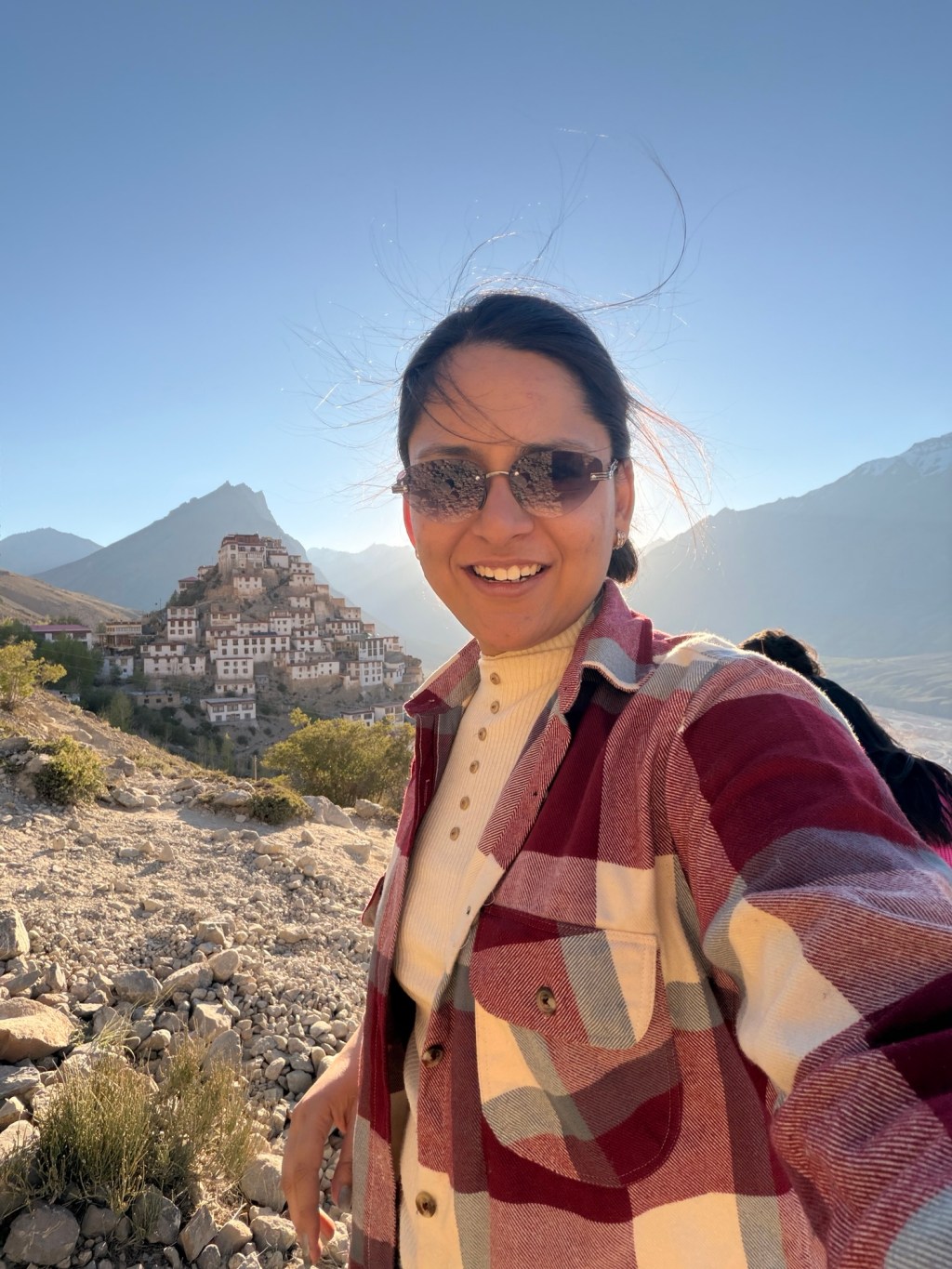
Key Monastery was one of the places I had most wanted to see. Set high against the mountain landscape, it looked incredible as we approached. We walked around, saw the entrance and took photographs. I remember being struck by how the monastery seemed to grow out of the hill itself.
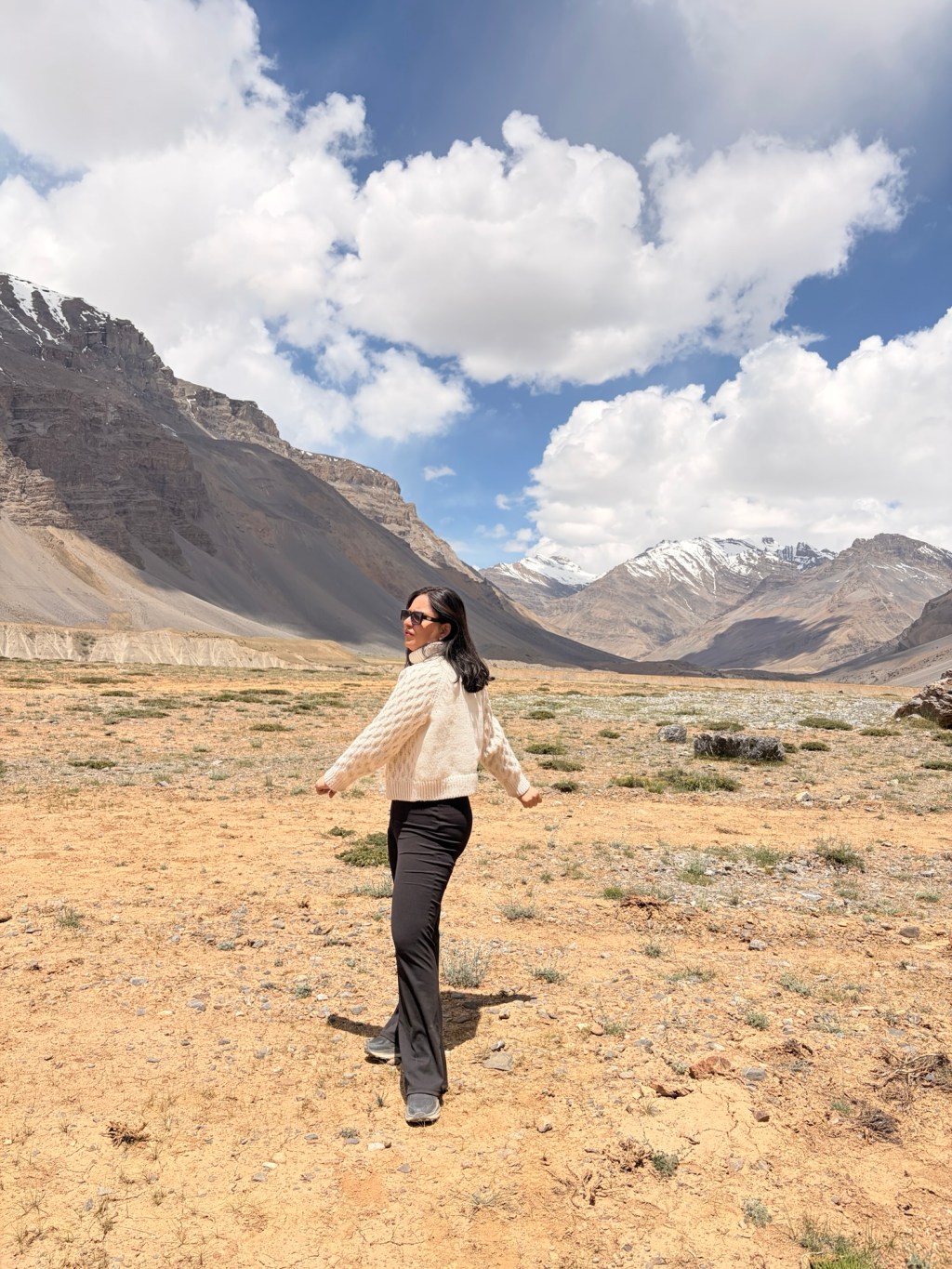
Chicham Bridge was another stop that day. We paused at the bridge and its entrance sign before continuing towards our stay for the night. By then, the day had been full of places I had seen in photographs and moments that were entirely our own.
03 / AFTER DARK
A Night Under a Sky Full of Stars
That night we stayed in a village in the Chicham and Kibber region. I don’t remember the exact village name, so I don’t want to pretend I do. Disha and I shared the homestay with a couple and three travellers from South India. Two solo travellers were staying nearby. The group had become more comfortable with one another, and the evening felt relaxed.
There was very little network. Once it got dark, the sky became the main event. We looked up and could see the Milky Way. It is difficult to describe how different the night sky feels when there are no city lights around and no phone demanding your attention. We stood there looking at it, taking it in.
But the night also brought a difficult moment. Around two in the morning, Disha’s head felt very heavy and she became worried. We were at high altitude, there was no oxygen cylinder in our room, and the lack of network made it harder to reach people quickly.
I managed to contact one of the travellers from our group. He came over, knocked on a neighbouring door and helped arrange an oxygen cylinder. I also reached one of the solo travellers nearby, who came with electrolytes, medicines and supplies. Both helped without hesitation, even though we had only known one another for a short time.
Disha eventually settled and managed to sleep. By morning she was feeling better, and I felt relieved. I remember that night because it reminded me how quickly a group of unfamiliar people can become people you can depend on.
We had arrived as strangers. In the middle of the night, we were looking out for one another.
It was also a reminder that high altitude should never be taken lightly. A severe or worsening headache, nausea, unusual tiredness, confusion or breathing difficulty needs prompt medical attention and help from trained professionals. Travel memories can be beautiful, but safety comes first.
04 / SNOW, MUSIC AND THE ROAD
Snow, Roads and a Little Campfire
A tyre puncture and an impromptu photo stop
The next day, our vehicle got a tyre puncture. We had to wait while it was fixed. The girls in the group decided not to waste the time: the scenery was too good, so we started getting photographs clicked. A small delay became another memory from the road.
A little café, Maggi and a guitar
We stopped at a small café along the way. It had low seating, prayer flags, photographs on the walls and a rustic outdoor feel. I don’t remember its name, so I’ll leave it unnamed. The food wasn’t particularly memorable, but the Maggi was great. Our trip captain played the guitar, and everyone sat around enjoying the music. It was one of those stops where the atmosphere mattered more than the menu.
Kunzum Pass — our first snowfall
Then we reached Kunzum Pass. There were snow-covered peaks, prayer flags and the small shrine and chortens at the pass. And then it started snowing. It was our first snowfall of the trip.
Disha and I got out and enjoyed it. We took photographs, stood in the snow and kept looking around, almost unable to believe we were actually there. On the way back into the vehicle, the gate hit my nose. It was a small, unfortunate interruption, but it isn’t what I remember most. What stays with me is the feeling of standing in that snowfall. It was one of the best moments of the journey.
Tenzin Camp, Batal — one more night together
We continued towards Batal and stayed at Tenzin Camp. There were tents, a bonfire, food, music and guitar. The captain played, people sang, we danced and spent the evening together. By then, the group no longer felt like a collection of people who had booked the same package. We had our own jokes and shared moments.
The next morning was cold and snowy. Getting out of bed was difficult, especially with another early start ahead. There were sheep around the camp, and the whole place looked different in the morning weather. I remember wishing we could stay a little longer, even though Chandratal was waiting.
05 / THE LAKE AND THE WAY BACK
The Lake, the People and the Road Back
Chandratal — the blue I had seen in photographs
The approach to Chandratal was snowy. There was snow on the ground, and I remember getting out to touch it and play around for a bit before we continued. The trail and the landscape made the arrival feel like part of the experience, not just a way to reach the lake.
Then we saw Chandratal: turquoise water surrounded by mountains, with snow still visible around the landscape. I had seen photographs of the lake before the trip, but being there was different. We stood by the water, took photographs and spent time looking at it. It was one of the highlights of the entire journey.
Chacha Chachi Dhaba — warmth in a remote place
We also stopped at Chacha Chachi Dhaba in Batal and met the elderly couple who run it. They were so sweet. In a remote stretch where there are few places to stop, the dhaba has become a familiar point for travellers. I was glad we got a photograph with them. It is easy to remember a trip through its landscapes, but the people you meet can stay with you just as strongly.
Back towards Manali
From Batal, we continued towards Manali and reached at night. There was more music, conversation and dancing along the way. We had spent days together, often with little or no network, and by then the group had its own rhythm. We had started out not knowing one another. Now we had a collection of shared memories.
One last adventure — Anjani Mahadev
We still had one more day in Manali. It was raining when we started from the hotel, and we didn’t have a vehicle arranged. We found a scooter rental place and decided to rent scooters. Other people from the group did the same, and soon we were riding through the rainy valley in our raincoats.
On the way, we stopped for momos, Maggi and tea. The valley was green and misty, and the rain made everything feel fresh. We completed the trek to Anjani Mahadev and saw the waterfall. We explored the area a little, although we were short on time.
Later, we went into Manali, bought a few magnets and returned to the hotel to collect our luggage. Then it was time to head home.
A Journey I Keep Wanting to Relive
When I think about Spiti, I don’t remember only one view or one destination. I remember the traffic jam that changed our first plan. The unexpected dancing at the viewpoint. The woman who welcomed us into her home. The students studying late at night. The children who let us join their cricket game in Nako. The postcards at Hikkim. The guitar at the café. The first snowfall at Kunzum. The bonfire at Tenzin Camp.
I remember the Milky Way and the people who came to help us at two in the morning. I remember touching the snow on the way to Chandratal, standing beside the lake and riding scooters through the rain in Manali. And I remember how Disha and I began the trip as two friends among strangers, and came back with so many more people and moments attached to the memory.
We didn’t visit every place on the larger Spiti circuit. Chitkul was missed on our first evening, and Kalpa stayed on the list for another time. Tabo, Dhankar and other popular stops belong in a broader route guide, but I don’t want to write about them as if I personally explored them on this trip.
The journey was adventurous, unpredictable, sometimes tiring and sometimes uncomfortable. But it also made me feel free, grateful and completely present. I wasn’t thinking about what came next or what was happening elsewhere. I was just there.
Maybe that’s why I keep wanting to relive it. Not because everything went perfectly, but because for those few days, I was completely living it.
THE LIFELATELY TRAVEL GUIDE
Planning a Spiti Valley Road Trip
This is a practical overview of the wider circuit, not a claim that every stop below was part of my own visit. Our actual experience included the Kinnaur approach, Khab Sangam, Nako, Gue, Komic, Hikkim, Key Monastery, Chicham Bridge, Kunzum Pass, Batal, Chandratal and Manali, along with the Anjani Mahadev visit.
The wider route
- Kinnaur approach: Shimla, Narkanda, Rampur, Karcham, Sangla and the Chitkul area.
- Entering Spiti: Khab Sangam, Nako, Gue and Sumdo.
- Other Spiti stops to plan: Tabo, Dhankar and Kaza. These are useful route additions, not places I am claiming to have visited on this trip.
- Kaza region: Key Monastery, Kibber, Chicham Bridge, Langza, Hikkim and Komic. The order can vary.
- Crossing towards Lahaul: Losar, Kunzum Pass, Batal and Chandratal.
- Return to Manali: Chhatru, Gramphu, Atal Tunnel and Manali, depending on the route and road conditions.
Things worth knowing before you go
- Plan for long drives. Mountain distances can take much longer than they look on a map. Keep buffer time for traffic, road work and weather.
- Check seasonal access. The route over Kunzum Pass is seasonal and can close because of snow. Check official road updates before travelling.
- Take altitude seriously. Build in time to acclimatise, avoid pushing through symptoms and seek medical help for severe or worsening symptoms.
- Expect limited connectivity. Network coverage can be patchy or absent in remote villages and on some road stretches.
- Pack for changing weather. Warm layers, waterproof outerwear, sturdy footwear and essential personal medication are useful even outside winter.
- Keep plans flexible. Our first evening changed because of a traffic jam. In the mountains, a flexible itinerary is often more realistic than a tightly timed one.
For current route information, check the official Lahaul and Spiti road status and the district administration’s how-to-reach guide. The Himachal Tourism Spiti Valley guide is useful for background on the region and its attractions. Conditions change, so verify details close to your travel dates.
If you’re planning a Spiti trip, leave room for the things you can’t schedule: a conversation, a game of cricket, a roadside pause, a song around a bonfire or a sky that makes everyone put their phones away. Those may become the parts you remember longest.
Life, lately.