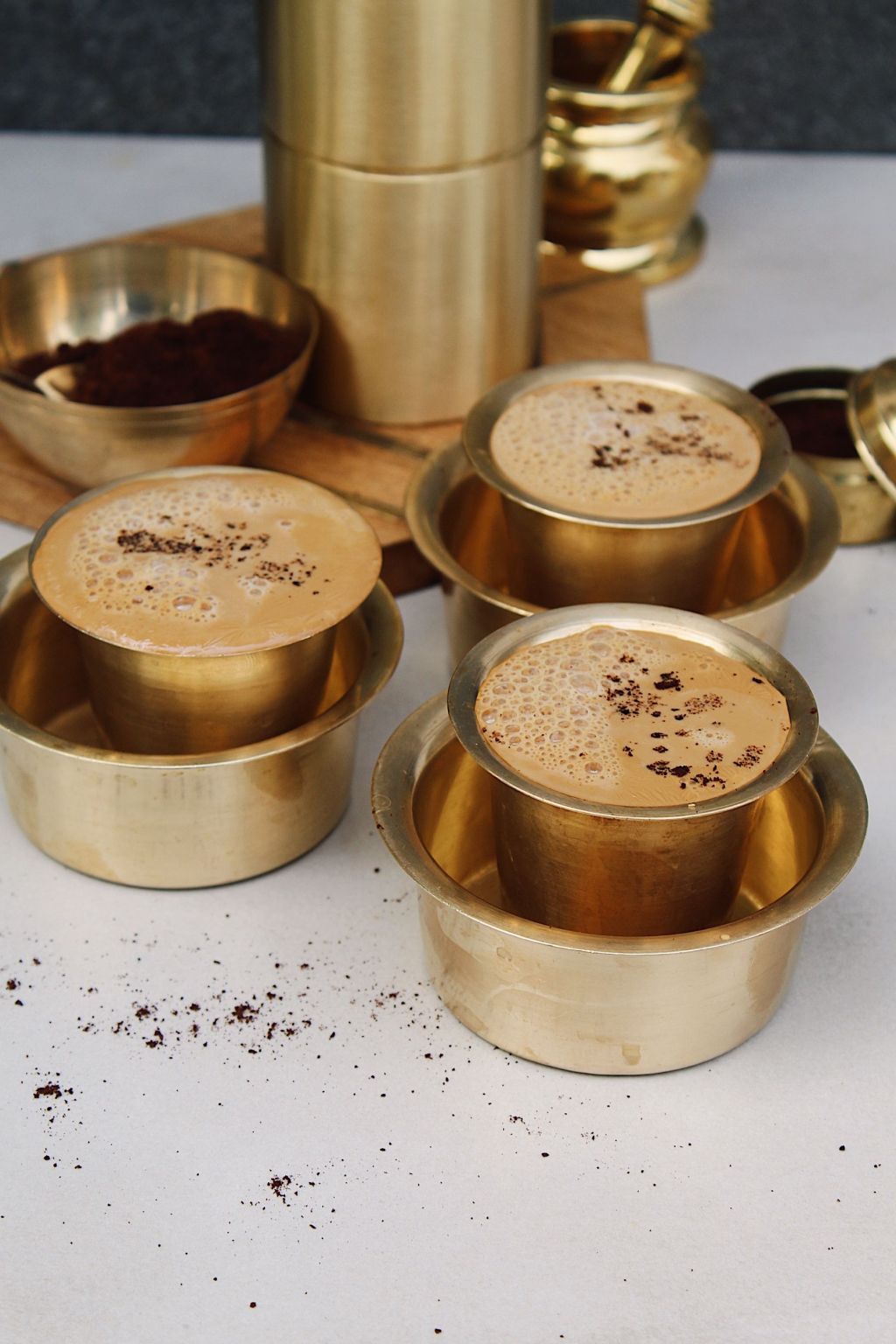
In much of South India, the day starts with the sound of coffee being poured from a height: from a steel tumbler into a wide steel bowl called a davara and back again, until it is frothy and cool enough to drink. Filter coffee is everyday, unfussy and deeply loved, and it has a surprisingly long history.
Seven beans and a legend
According to a well-known legend, a Sufi pilgrim named Baba Budan smuggled seven coffee beans back from his pilgrimage to Mecca around 1650 and planted them in the hills of Chikmagalur, in present-day Karnataka. The range is still called Baba Budangiri.
Coffee is now a major crop in South India. In the Coffee Board of India’s latest estimate, Karnataka grows about 69 per cent of the country’s coffee, Kerala about 21 per cent and Tamil Nadu about 5 per cent.
Why chicory?
Traditional filter coffee is made from dark-roasted coffee, often arabica or peaberry, blended with chicory, the roasted root of a plant related to the dandelion. A typical blend is somewhere between 80 and 90 per cent coffee and 10 to 20 per cent chicory. Chicory adds body, a slight bitterness and a darker colour, and it helps the coffee stand up to plenty of hot milk.
The two-chamber filter
The brewer itself is simple: two stacked stainless-steel cylinders. Ground coffee goes into the upper chamber, which has a perforated base, and is pressed down with a small disc. Boiling water is poured in, the lid goes on, and a strong decoction drips slowly into the lower chamber. The decoction is then mixed with hot milk and sugar and frothed by pouring between the tumbler and davara.
Degree coffee and the Indian Coffee House
Kumbakonam in Tamil Nadu gave its name to one of the most celebrated styles, Kumbakonam degree coffee, made with pure cow’s milk and fresh decoction. Explanations of the word “degree” vary, and none is definitive.
The coffee house has a history of its own. The first India Coffee House opened at Churchgate, Bombay, in 1936, run by the Coffee Board. When the Board decided to close its coffee houses in the 1950s, workers, encouraged by the leader A. K. Gopalan, formed co-operatives to take them over. The first co-operative societies were set up in Bangalore and Delhi in 1957, and the Indian Coffee House network today has nearly 400 outlets run by 13 co-operative societies.
How to make it at home
- Put about 3 tablespoons of filter coffee powder in the upper chamber and press it lightly with the disc.
- Pour in boiling water to just below the top, close the lid and leave it to drip for 10 to 15 minutes. Do not rush it.
- Heat milk until it is just about to boil.
- In a tumbler, mix a few tablespoons of decoction with the hot milk and sugar to taste. Adjust the strength to suit you.
- Pour back and forth between the tumbler and davara a few times to froth it, and serve straight away.
Look for powders labelled with their coffee-to-chicory ratio, and start with a blend of around 80:20 if you are new to it.
Sources
- Indian filter coffee
- Coffee statistics, Coffee Board of India
- Indian Coffee House
- Kumbakonam degree coffee
Lead photo: Akshata Bablad / Pexels. Facts checked against the sources above in October 2026.