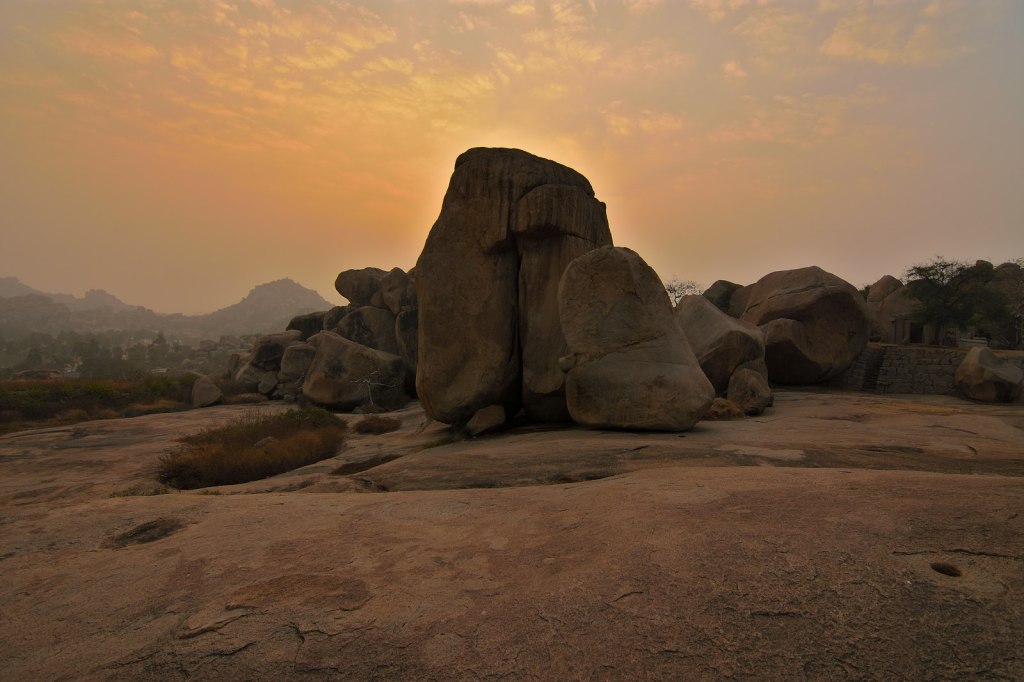
For two centuries Vijayanagara was one of the largest and richest cities in the world, the capital of an empire that controlled much of South India. In 1565, after the Battle of Talikota, it was sacked and abandoned. What remains at Hampi, scattered among granite boulders along the Tungabhadra river, is one of India’s most extraordinary landscapes. It was inscribed as a UNESCO World Heritage Site in 1986.
The Sacred Centre
The village of Hampi grew up around the Virupaksha Temple, which is older than the empire and still in worship; its tall gateway tower dominates the bazaar street. Above it, Hemakuta Hill is covered in small early temples and is a favourite place to watch the sunset. At the far end of the bazaar, steps climb Matanga Hill, the best viewpoint for sunrise.
The Vittala Temple
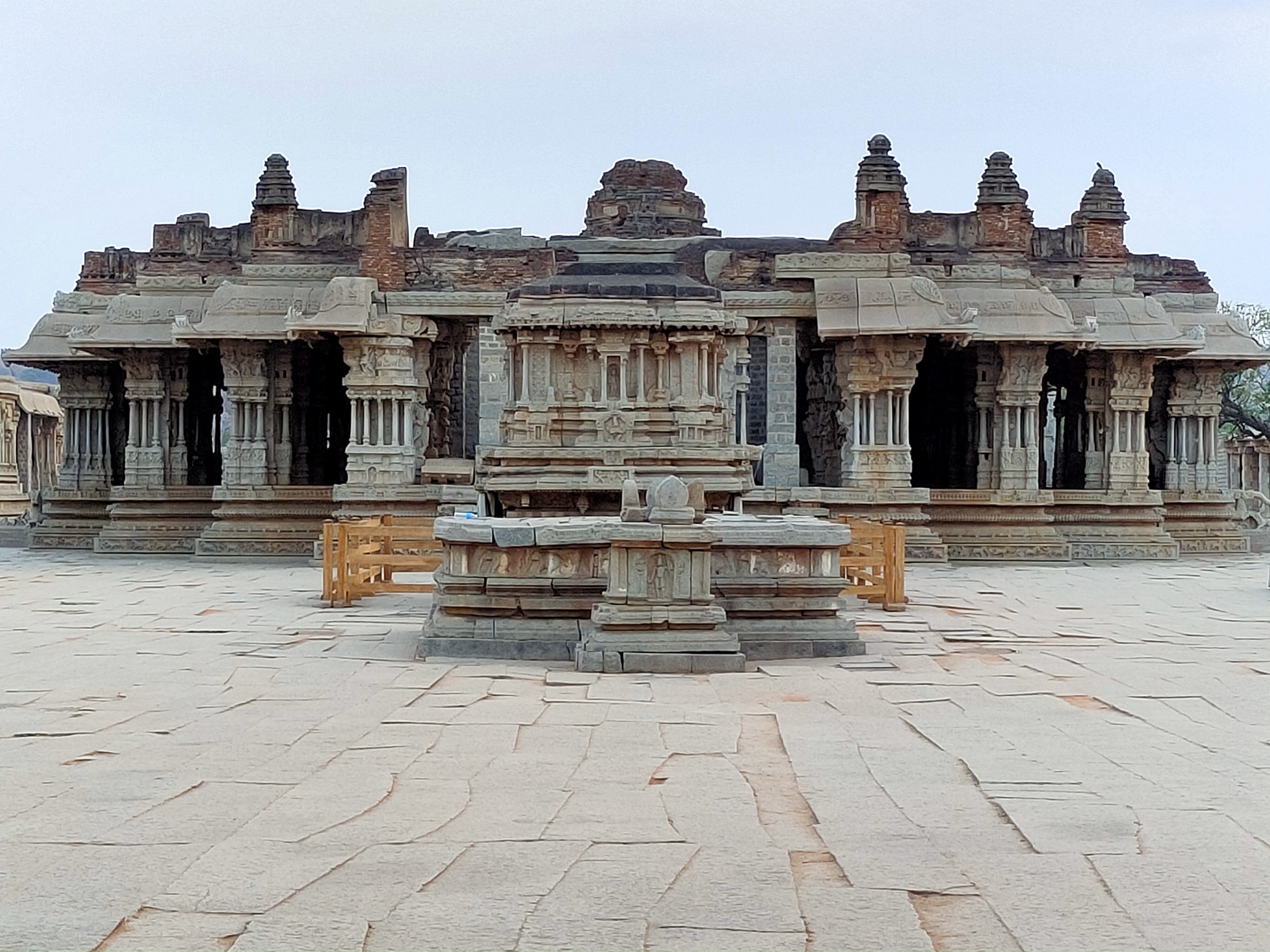
A walk along the river leads to the Vittala Temple complex, the finest work of Vijayanagara architecture. Its pavilions are carved with horses, dancers and musicians, and its famous stone chariot, a shrine for Garuda, has become a symbol of Karnataka. The ‘musical pillars’ of the main hall are now protected and may not be tapped.
The Royal Centre
To the south, the royal enclosure holds the great platform from which kings watched the Mahanavami festival, a stepped tank, the Lotus Mahal and a long row of domed elephant stables. The Hazara Rama Temple nearby is covered in friezes of processions and the Ramayana.
Across the river
Coracles, round boats of woven bamboo, still cross the Tungabhadra in places, and the Anegundi side has quieter villages, paddy fields and older shrines. River levels rise sharply in the monsoon, so ferries and coracles may not run.
Planning
- Getting there: Hosapete (Hospet) is the nearest railway station, about 13 kilometres away; there are overnight trains from Bengaluru.
- Getting around: hire a bicycle, an electric vehicle or an auto-rickshaw with a driver; distances between sites are long.
- Time needed: two full days at least; three is better.
- When to go: October to February. From March the heat is intense and there is little shade.
- Respect: do not climb on monuments, and dress modestly at working temples.
More in our Karnataka guide.
Sources and image credits
Facts that can change were checked on 30 October 2026:
- UNESCO: Group of Monuments at Hampi
- Wikipedia: Hampi
- Wikipedia: Vittala Temple
- Karnataka Tourism (official)
Photography: P Mantha via Unsplash (Unsplash License); Makarand Mane via the WordPress Photo Directory (CC0). Not the author’s own.
Ticketing and access are managed by the ASI and local authorities and can change. Check before you go.