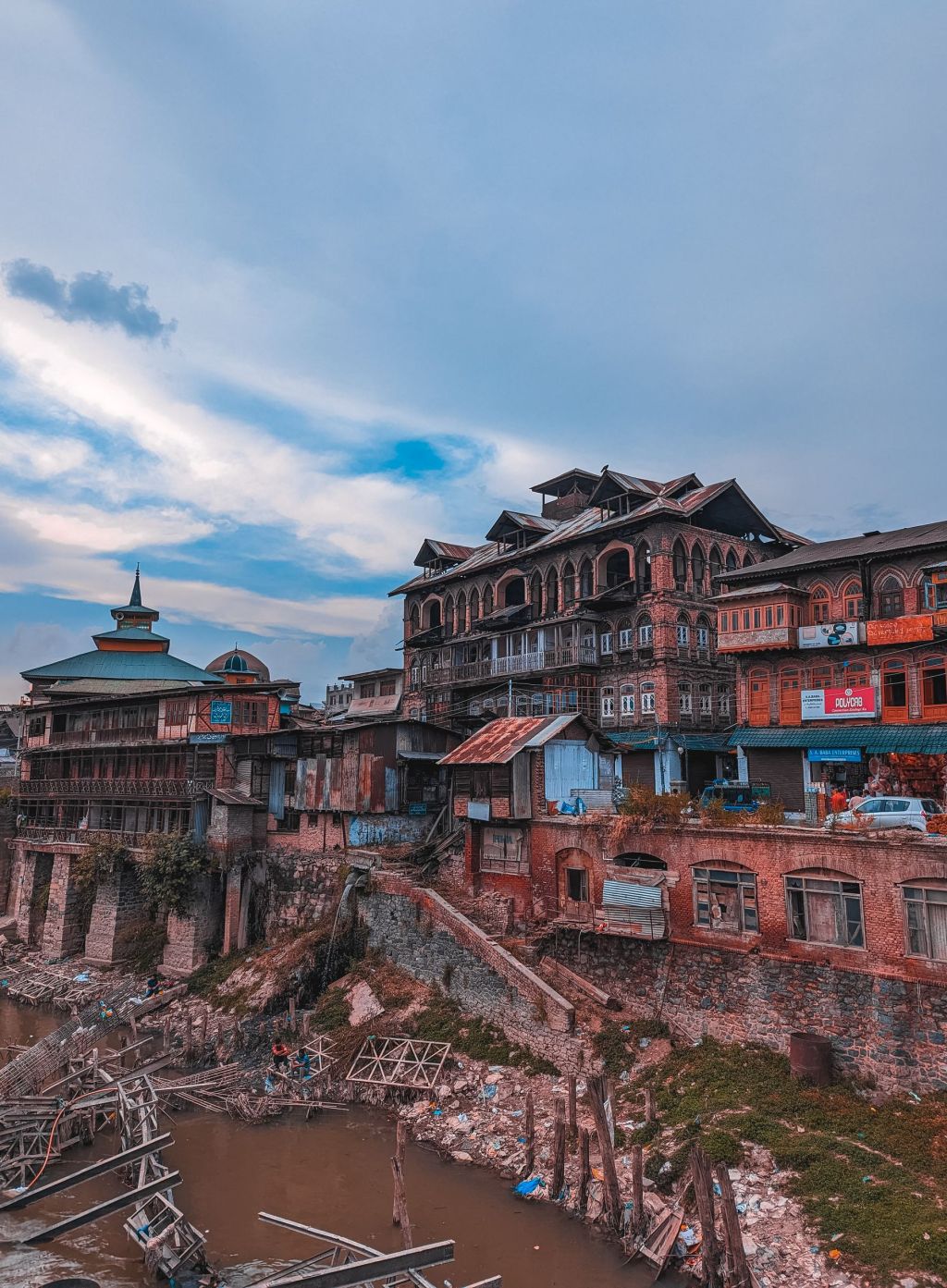
Most visitors to Srinagar see the city from Dal Lake. The older city lies a short drive south-west, along the Jhelum: Shahar-e-Khaas, or Downtown, the largest and most densely populated part of Srinagar. Here the landmarks are wooden shrines, a 17th-century stone mosque and a Friday mosque held up by hundreds of timber columns, joined by bridges and lanes of brick and timber houses. It rewards a slow morning on foot.
Khanqah-e-Moula
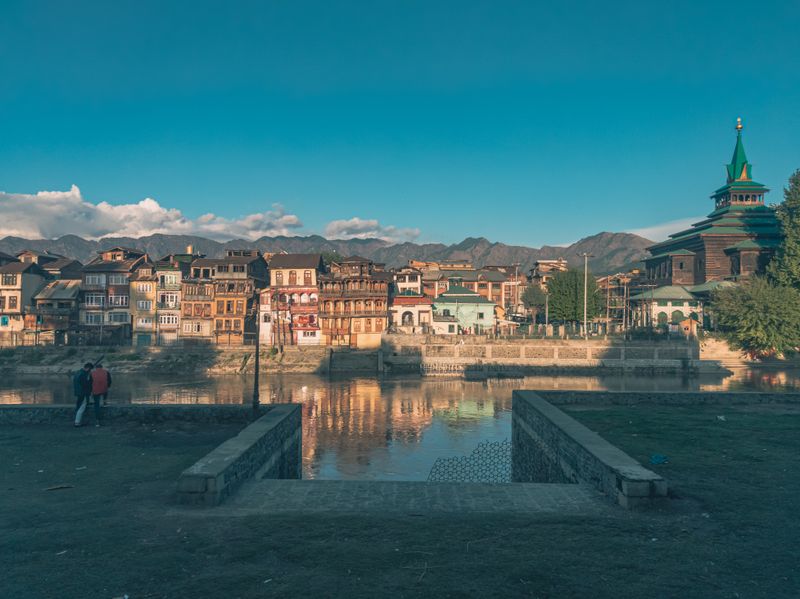
On the right bank of the Jhelum, between the Fateh Kadal and Zaina Kadal bridges, stands Khanqah-e-Moula, also called the Shah-e-Hamadan shrine. It was first built in 1395 by Sultan Sikandar in memory of the Sufi teacher Mir Sayyid Ali Hamadani, and is considered the first khanqah in the Valley. Fire destroyed it in 1480 and again in the 18th century, and it was rebuilt each time. A fire damaged its spire in November 2017; a restored crown was installed in March 2018.
It is one of the finest examples of Kashmiri wooden architecture, with carved woodwork and painted papier-mâché inside. It is an active mosque and a Monument of National Importance. Rules on who may enter the prayer hall are set by the shrine, so ask at the gate and follow the caretakers’ guidance.
Pathar Masjid
Across the river is a building that looks nothing like its neighbours. Pathar Masjid, the “stone mosque”, was built in 1623 under the patronage of Empress Nur Jahan, wife of the Mughal emperor Jahangir, in grey limestone rather than wood. The Archaeological Survey of India declared it protected in the 1970s. It is still used for prayer, mostly in summer, when the stone keeps it cool.
The Jamia Masjid
At Nowhatta, the Jamia Masjid is the city’s great Friday mosque. Sultan Sikandar commissioned it in 1394, and it was completed in 1402. Its roof rests on 378 wooden columns, the tallest of deodar, around a courtyard laid out as a four-part garden with a central pool. Fire destroyed it three times, and each time it was rebuilt. Its pyramidal roofs and turrets show the blend of Persian and local Kashmiri building traditions you see across the old city.
- It holds tens of thousands of worshippers on Fridays and festivals. Visit outside prayer times.
- Dress modestly, cover your head if asked, and remove your shoes where indicated.
- Ask before photographing people.
Bridges, markets and the Sultan’s city
The old city grew along the Jhelum, crossed by a series of bridges whose names, ending in kadal, still name its neighbourhoods. Zaina Kadal takes its name from the 15th-century Sultan Zain-ul-Abidin. Nearby, the brick Budshah tomb is traditionally identified as the tomb of his mother, and the Maharaj Gunj market area was long a wholesale hub for goods such as copperware and spices.
Upstream, the old Habba Kadal bridge was restored as a pedestrian walkway, with new wooden decking, kiosks and a rebuilt ghat. It was reopened in January 2024 as part of Srinagar’s riverfront works. It is a good place to pause and watch the river.
Hari Parbat and Badamwari
The hill of Hari Parbat (Koh-e-Maran) rises above the northern edge of the old city, with a fort on its crest and shrines of several faiths on its slopes. The fort was opened to the public in 2016, but access arrangements can change, so check locally. At its foot, the Badamwari almond garden, replanted with almond trees under the Dogra ruler Ranbir Singh, flowers for a few weeks in March.
Eat on the way
The old city is where much of Srinagar’s everyday food is made. Look for a kandur baker in the morning for girda and tsochwor with noon chai. In winter, from about October to March, look for harissa: the harissa shops of Nawakadal and Gratabal start serving early and often sell out by mid-morning. Our guide to Kashmiri food explains what to order.
A simple route
- Start at the Jamia Masjid in Nowhatta in the early morning.
- Head down to the river and Khanqah-e-Moula, then look across to Pathar Masjid on the opposite bank.
- Walk to Zaina Kadal, the Budshah tomb and the Maharaj Gunj lanes.
- Finish on the restored Habba Kadal walkway, or take a taxi to Hari Parbat and Badamwari.
Allow two to three hours on foot, longer if you stop to eat. Hire a local guide if you can: the lanes are a maze, and a guide can explain what you are seeing.
Before you go
- Go early: the light is softer and the lanes are quieter.
- Wear comfortable shoes with grip. Cobbles and steps can be uneven and slippery after rain.
- These are lived-in neighbourhoods. Keep voices low, respect residents’ privacy and ask before taking photographs.
- Conditions in Jammu & Kashmir can change at short notice. Check current advisories and our Kashmir safety notes before you plan.
More from Srinagar: our Kashmir Valley guide and five days in Kashmir.
Sources and image credits
Facts that can change were checked on 29 October 2026:
- Wikipedia: Khanqah-e-Moula
- Wikipedia: Jamia Masjid, Srinagar
- J&K Arts Foundation: The Pathar Masjid
- Wikipedia: Downtown, Srinagar
- Kashmiril: Srinagar old city heritage walk (Zaina Kadal, Budshah tomb, Maharaj Gunj)
- Greater Kashmir: revamped Habba Kadal bridge inaugurated (16 January 2024)
- Business Standard / PTI: Hari Parbat fort open for public (2016)
- Incredible India: Almond blooms, Badamwari
- People’s Archive of Rural India: In Srinagar, harissa is best served hot
Photography via Pexels, used under the Pexels License: Umar Andrabi (houses on the Jhelum), Farhaan Mushtaq Parimoo (Khanqah-e-Moula). These are stock images, not the author’s own.
Access to shrines and monuments, and local conditions, can change. Check locally before you go.