Bollywood · September 2026
From Patola and Kanjeevaram to a corseted saree and a farshi salwar in lime green, September brought a distinctly Indian fashion conversation to Bollywood.
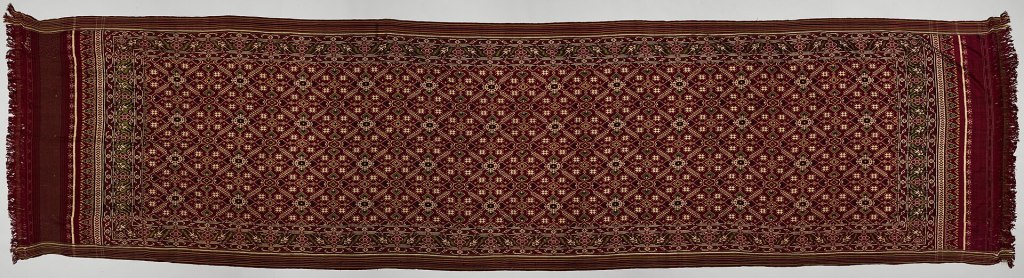
Lead image: a Patan Patola double-ikat silk, India, 1900–1949 — the same weave as Look 01, not the saree worn in September. Rijksmuseum, public domain (CC0).
Ganesh Chaturthi ran for ten days this year, ending with Anant Chaturdashi and the Ganpati visarjan on 25 September. As Outlook Luxe put it in its round-up of the festival’s celebrity looks, those ten days offered a snapshot of how Indian festive dressing is changing. We looked at the same looks and asked a simpler question: what do they tell us about Indian style right now?
The looks
Look 01 · Patan Patola
Janhvi Kapoor
Gujarat’s double-ikat Patan Patola by Nidhi Tambi Kejriwal, in deep pink and blue, draped Gujarati-style — the textile itself was the statement.
Look 02 · Zardozi + corset
Alia Bhatt
An icy-blue custom Masaba Gupta saree with zardozi and a strapless corset blouse — then, for visarjan, a fuchsia short kurta over a lime-green farshi salwar.
Look 03 · Mustard anarkali
Kareena Kapoor Khan
A mustard Anamika Khanna anarkali with a heavy zari border, softened by a single pearl necklace.
Look 04 · Yellow Bandhani
Ananya Panday
A yellow Bandhani by Arpita Mehta with a gold border — and turquoise earrings as the one unexpected note.
Look 05 · Pink Chanderi
Kiara Advani
A pink Chanderi saree, kept quiet so an emerald-and-diamond necklace could do the talking.
Look 06 · Milan
Aditi Rao Hydari
Away from the festivities: leather on leather at Milan Fashion Week.
What we noticed
01 — The textile was the headline. Patola, Kanjeevaram, Chanderi and Bandhani were named as often as the designers.
02 — Old techniques, new construction. Zardozi on a saree, worn with a structured corset.
03 — Historic silhouettes, unexpected colour. A farshi salwar in lime green is not your grandmother’s version.
04 — One piece of jewellery, chosen carefully. An emerald necklace, a pearl strand, turquoise earrings — each look let one piece lead.
Our read, based on the looks documented by Outlook Luxe, which itself described the festival’s looks as blending heritage textiles, sculptural jewellery and unexpected colour.
Tradition, without looking traditional
Our read
None of these looks rejected tradition. Most of them leaned on it harder than ever — naming the weave, the region, the technique. What changed was the way it was worn: a corset where you’d expect a blouse, a salwar shape from another century in a colour from this one, a single necklace instead of a full set. It’s the same instinct we noticed on the streets of Paris this month. The most interesting clothes have a history. They just don’t wear it like a costume.
Read alongside: what the street wore at fashion month in The September Style Report; two festive dress codes compared in Same Nine Nights, Dressed Differently; and the Indian labels building on craft in Small Labels We’re Watching.
Your take
Which September look would you actually wear?
Tell us your pick — and how you’d wear it
About the images: photographs of these looks belong to the photographers, publications and people in them. We only show an image here once we have permission or a licence to do so, and we credit it.