Kochi grew rich on pepper. For centuries traders from Arabia, China and Europe came to this harbour, and the Portuguese, Dutch and British each left their mark. Fort Kochi and neighbouring Mattancherry, on the peninsula across the water from modern Ernakulam, hold that history in a compact grid of streets that is best explored on foot or by bicycle.
The fishing nets and the waterfront
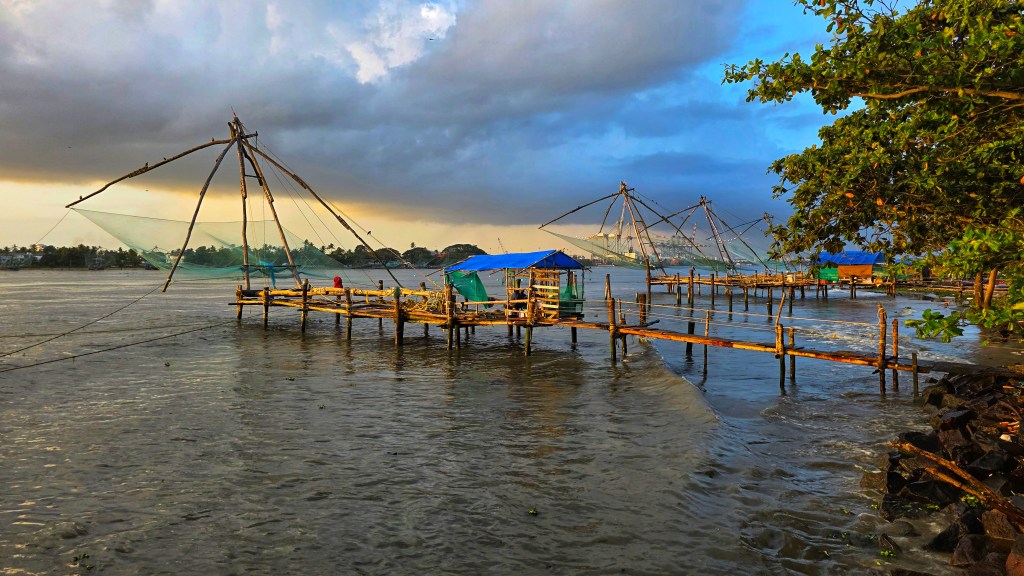
The cantilevered Chinese fishing nets, cheena vala, line the shore at the mouth of the harbour. Teams of fishermen lower and raise them with counterweights of stone; the nets are thought to have been introduced through trade with China. Early morning and late afternoon are the best times to watch, and the fish market beside them sells the catch.
Churches and colonial streets
St Francis Church, built by the Portuguese in the early sixteenth century, is one of the oldest European churches in India. Vasco da Gama died in Kochi in 1524 and was first buried here, before his remains were taken back to Portugal. Nearby, the Santa Cruz Cathedral Basilica has a bright painted interior. The streets between are lined with old Dutch and British bungalows, many now guesthouses and cafés.
Mattancherry
A short ride south, the Mattancherry Palace, often called the Dutch Palace, was built by the Portuguese in the sixteenth century as a gift to the Raja of Kochi. Its rooms hold some of the finest Kerala murals, scenes from the Ramayana painted in rich natural colours.
Beyond lies Jew Town, where the Paradesi Synagogue, built in 1568, is the oldest active synagogue in the Commonwealth, with hand-painted Chinese floor tiles and Belgian chandeliers. Very few of Kochi’s Jewish community remain. The synagogue has limited opening hours and closes on the Sabbath and Jewish holidays.
The lanes around are full of spice warehouses, antique shops and ginger godowns, some converted into galleries.
Evenings and events
- Kathakali, Kerala’s classical dance-drama, is staged nightly for visitors at several small theatres; arrive early to watch the performers apply their make-up.
- The Kochi-Muziris Biennale, India’s largest contemporary art exhibition, is held roughly every two years in warehouses and heritage buildings across Fort Kochi, usually opening in December.
Practical notes
- Getting there: state ferries and the Kochi Water Metro link the islands and Ernakulam; the crossing is cheap and pleasant.
- Getting around: walk, cycle or take an auto-rickshaw between Fort Kochi and Mattancherry.
- When to go: October to March. Rain is heavy from June to September.
Continue to the hills and backwaters with our Kerala guide.
Sources and image credits
Facts that can change were checked on 30 October 2026:
- Wikipedia: Fort Kochi
- Wikipedia: Chinese fishing nets
- Wikipedia: Mattancherry Palace
- Wikipedia: Paradesi Synagogue
- Kochi-Muziris Biennale (official)
Photography: Jose Varghese via the WordPress Photo Directory (CC0). Not the author’s own.
Opening days and hours change, particularly at religious sites. Check before you go.