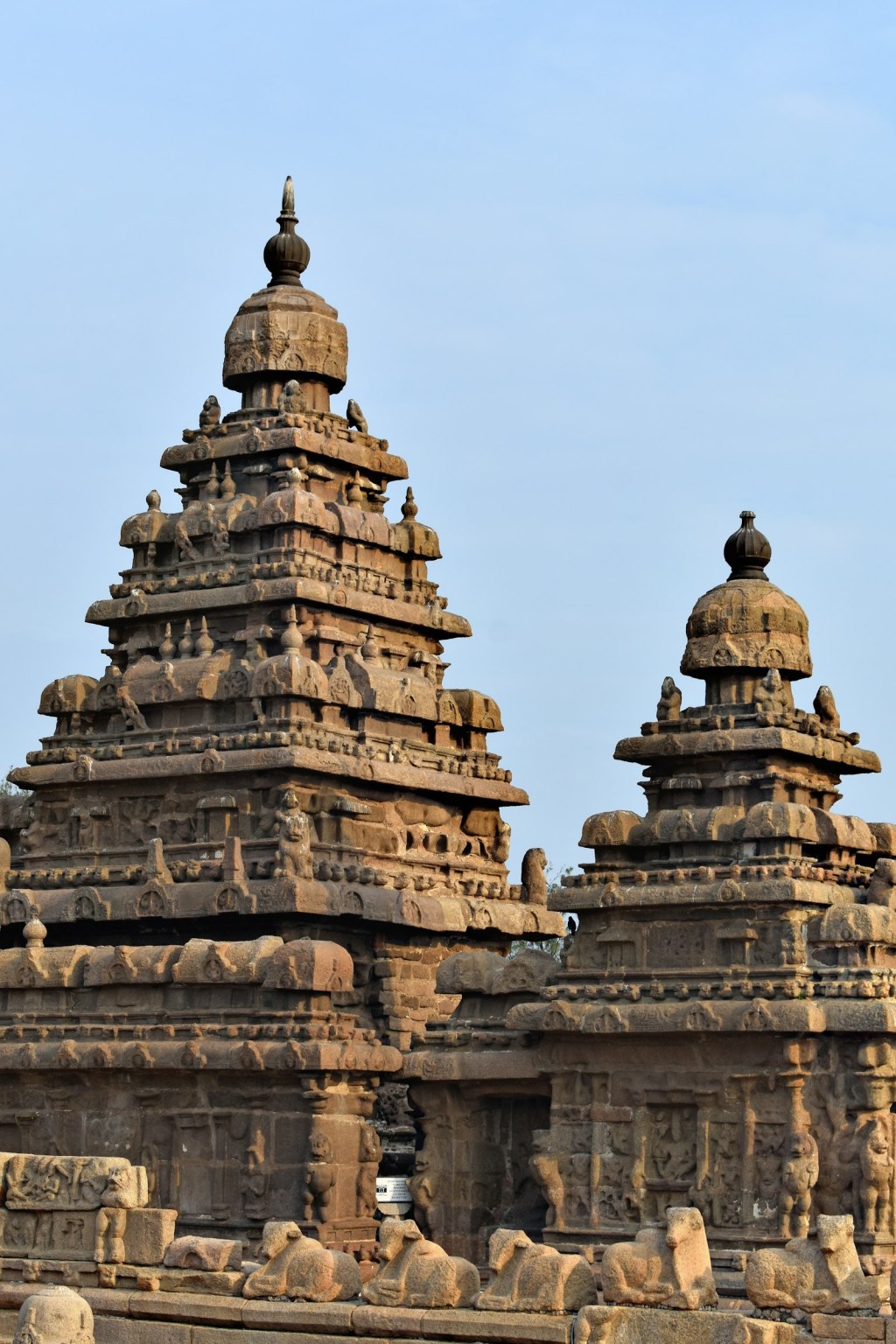
Mahabalipuram, also called Mamallapuram, was a port of the Pallava kings in the seventh and eighth centuries. Here, on a stretch of coast about 55 kilometres south of Chennai, their sculptors cut temples, reliefs and shrines from the granite itself. The Group of Monuments at Mahabalipuram was inscribed as a UNESCO World Heritage Site in 1984, and it remains one of the best places in India to see how South Indian temple architecture began.
The Shore Temple
Built in the early eighth century, the Shore Temple stands right at the edge of the Bay of Bengal, with two towers dedicated to Shiva and a shrine to Vishnu between them. Centuries of salt wind have softened its carvings. Go early in the morning, when the light is low and the site is quiet.
Arjuna’s Penance
In the town centre, a huge relief covers two boulders with gods, people, animals and a pair of life-size elephants, all converging on a natural cleft in the rock. It is read either as Arjuna’s penance from the Mahabharata or as the descent of the Ganges; scholars still debate which. Nearby are cave shrines, or mandapas, carved with panels of Durga fighting the buffalo demon and Vishnu sleeping on the cosmic serpent, and the great balancing boulder known as Krishna’s Butter Ball.
The Five Rathas
South of town, the Pancha Rathas are five shrines each carved from a single rock outcrop, in the form of temple chariots. Each shows a different architectural style, almost like a sample book of designs, alongside monolithic sculptures of an elephant, a lion and a bull.
The stone carvers
Mahabalipuram is still a town of sculptors. Workshops line the roads, carving deities and figures in granite and soapstone, and Tamil Nadu’s government college of architecture and sculpture is based here. Buy directly from workshops, and ask how pieces will be shipped if they are heavy.
Planning
- Getting there: about 90 minutes by road from Chennai along the East Coast Road; easy to combine with Puducherry further south.
- Time needed: a full day covers the main monuments; stay overnight for sunrise at the Shore Temple.
- When to go: November to February. Afternoons are very hot from April to June, and October to December brings the north-east monsoon.
- Tickets: some monuments are ticketed by the ASI; buying online can save queuing.
- Festival: a classical dance festival is usually staged against the reliefs in December and January.
Continue south with our Tamil Nadu guide or our Puducherry guide.
Sources and image credits
Facts that can change were checked on 30 October 2026:
- UNESCO: Group of Monuments at Mahabalipuram
- Wikipedia: Group of Monuments at Mahabalipuram
- Wikipedia: Descent of the Ganges (Mahabalipuram)
- Archaeological Survey of India (official)
Photography: Brijender Dua via Unsplash (Unsplash License). A stock image, not the author’s own.
Ticketing and opening hours are set by the Archaeological Survey of India and can change. Check before you go.